
VTS SeaWatch®
MARITIME SITUATION ANALYSIS

SeaWatch® is a vessel trafic services solution dedicated to the surveillance of sensitive areas.
It is designed for players who want to control their knowledge of coastal approaches or sensitive areas such as commercial ports, military harbors, offshore or wind farms, or marine protected areas.
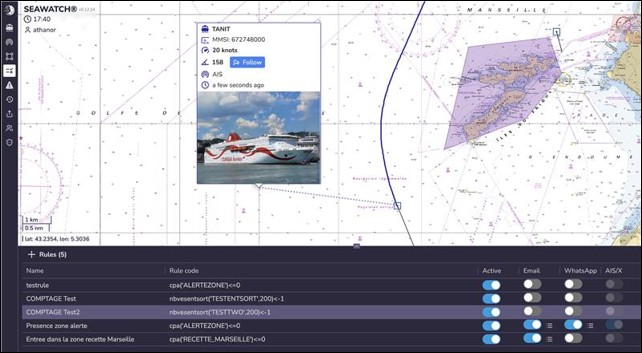
The VTS SEAWATCH solution is an innovative development for real-time monitoring and control of maritime traffic. Interconnectable with multiple sensors, the solution analyzes ship behavior and identifies any abnormal or suspicious behavior.
In details :
- Full Web solutions with secure access by OTA
- Real-time monitoring of the maritime situation in the critical zone and its approaches.
- User-defined rules for abnormal behavior detection.
- Artificial intelligence for maritime traffic analysis.
- Replay of a past event via a replay function (trafic, videos…)
- Automatic recording of alerts (creation of a share link) and replay (basic duration 1 month).
- Documented computer interface (api) for adding
- Export/Import data (vessels/zones/rules/alerts) to another system trough IVEF format.
- Broadcast information and alerts in real time:
- cooperative vessels (protection/maintenance vessels, etc.).
- to the relevant authorities (cross, maritime police, etc.).
- to the platform administrators.
Sensors and communication methods
In order to connect different sensors, SeaWatch is supplied with standard interfaces: NMEA 183, ASTERIX (Radar), RTSP stream, OnVIF (EOS), VoIP (Communications).
With experience gained from several deployments, ATHANOR can assist you in choosing sensors from leading suppliers. With regard to AIS, ATHANOR is able to supply base stations that comply with IALA or military standards (STANAG 4668 & 4669).
Standards and regulations
VTS complies with IMO standards for maritime surveillance, in particular:
- General standard for the design, operation and management of a VTS (IALA S1040)
- Requirements for the qualification of VTS personnel (IALA S1050)
- Data management, information exchange and VTS reporting (IALA S1070)
- Functional and technical requirements for VTS equipment (Recommendation R0128)
- Requirements for the use and presentation of symbols/displays in a VTS centre (Recommendation R0125)
- Guidelines for establishing functional and performance requirements for VTS systems and equipment (Guidelines IALA G1111)
Use of artificial intelligence (AI)
Integration of a hybrid rules engine, to “understand” the meaning of alerts.
User-defined rules automatically parameterized by AI.
Adaptation to the real situation in the field requires a learning curve of around ten days (or several months, if seasonal phenomena are taken into account);
Image analysis for complete visibility of maritime traffic: Detection and recognition of ship type and positioning.
Map
- Vectoriel : S-57, S-63, S-101
- Raster